If you’ve shopped for a roof replacement or an alternative roof restoration solution, you’ve probably heard words like restore, preserve, rejuvenate and renew used interchangeably. And usually with a big warranty number attached. They don’t mean the same thing though, and the difference matters more than the number of years printed on the brochure.
Every roof restoration product falls somewhere between two approaches: rejuvenate what’s left with a roof rejuvenation treatment, or rebuild what’s been lost with roof resurfacing. Only one of them adds anything back to your roof.
Here’s how to tell what a product actually does to your roof.
The granules are your roof’s real protection. Everything underneath depends on them.
An asphalt shingle has three main layers:
Drying out is the symptom. Granule loss is the cause. Asphalt contains natural oils that keep it flexible, and the granules are what protect those oils from the sun. Once the granules wash off, the asphalt is exposed. The sun bakes the oils out, and the shingle gets brittle, cracks and curls. Then the roof needs replacing.
So when you’re comparing roof products, it helps to know which problem each one is solving. Some are built to slow the drying out, by putting oils back into the asphalt or sealing what’s there. Others are built to restore the protection, by replacing the granules that have worn away. Both have a place. Which one makes sense depends on how much of the granule layer your roof still has.
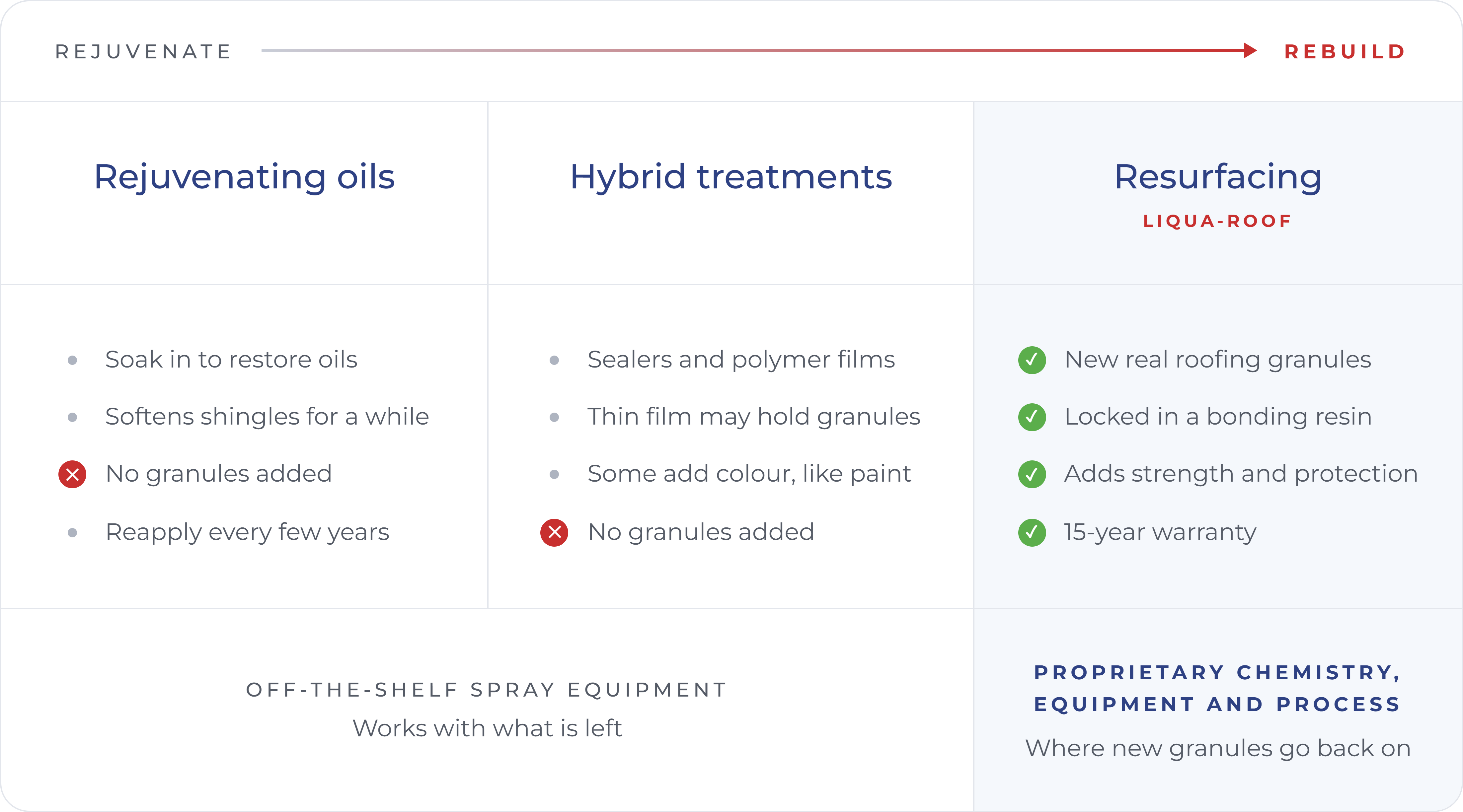
Rejuvenating and rebuilding sit at opposite ends of a spectrum. Most products on the market sit at the rejuvenate end or somewhere in the middle.
Rejuvenate (one end). Oil-based treatments soak into the shingle to replace oils the asphalt has lost. The shingle gets more flexible for a while. Nothing is added to the surface, and the oils wear off, so reapplication every few years is part of the deal.
Hybrids (the middle). Sealers, nano-particle formulas and polymer “preservation” treatments penetrate a bit deeper and may leave a thin film on top. That film can help hold the remaining granules in place a little longer. Some add colorant to refresh the look, which is basically a thin paint. These are a step up from oil, but they’re still working with what’s left.
Rebuild (the other end). Liqua-Roof’s resurfacing system adds a new layer of real roofing granules, locked in a resin that bonds to the shingle and to the original granules. It replaces what’s been lost and adds more on top.
The line that matters is between the middle and the end. Until new granules go back on the roof, it’s preservation. Better preservation, maybe, but still preservation.
Granules are your roof’s sunscreen.
Asphalt dries out because the sun bakes it. Rejuvenating oils are moisturizer: they put moisture back, and the shingle is better for a while. But with the granules gone, nothing is blocking the sun, so it dries right out again. That’s why rejuvenators need reapplying every few years. They treat the symptom, not the cause.
Hybrid films are like a light lotion with a bit of SPF. Better than nothing, but it still wears off.
Resurfacing puts the sunscreen back. And unlike real sunscreen, it doesn’t come off. Our Granulock™ technology locks the granules in place with a resin that bonds to the shingle, so there’s nothing to reapply.
Preserving a shingle can slow its decline. Rebuilding it can make it perform better than it did new.
A thin film and a thick, granule-filled layer are physically different things, and independent testing shows it. Here’s how Liqua-Roof resurfaced shingles compared with new, uncoated shingles:
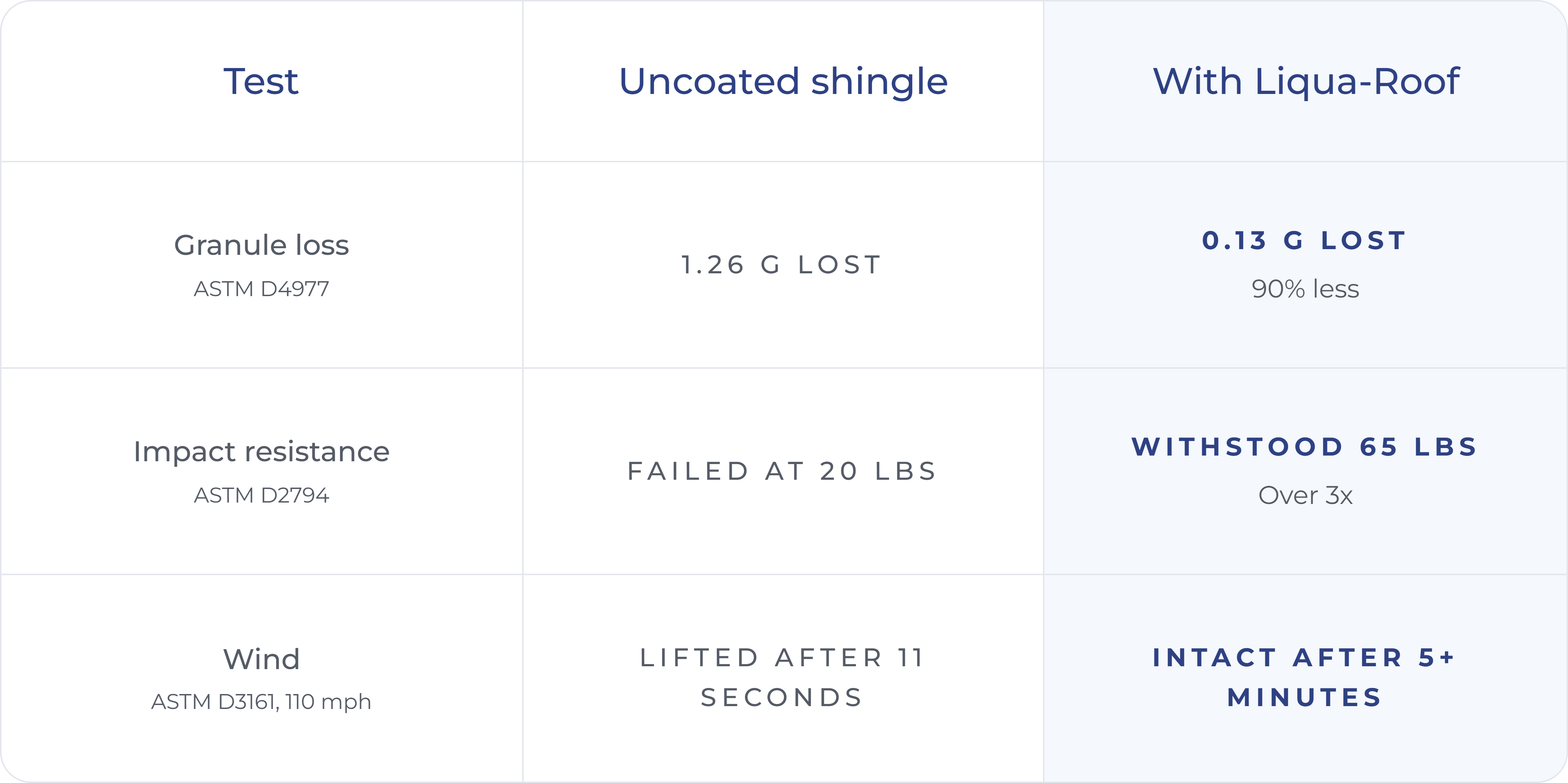
Liqua-Roof resurfaced shingles also passed UL 2218 Class 4, the highest hail impact rating there is.
None of that comes from softening the asphalt. It comes from adding granules back and locking them in. Full results are on The Science page, and there’s a side-by-side breakdown in Roof Resurfacing vs Roof Rejuvenation.
Everything from oils to hybrid films can be applied with off-the-shelf spray equipment. A thin liquid goes in a standard sprayer and onto the roof. That’s a relatively low barrier, which is why there are so many companies doing it.
Resurfacing is a different problem. Spraying real roofing granules suspended in resin, evenly, at the right thickness, and getting them to bond to an aged shingle takes three things you can’t buy at a supply store:
It took us years of R&D to get there, and we’ve been granted patents in both Canada and the US. Not patent pending. Patented. Resurfacing is a far more engineered system, with the chemistry, equipment and application process all built to work together. It’s also what’s best for the roof.
A warranty’s length tells you less than what it actually covers.
Any company can print 17, 20 or 50 years on a brochure. The number is a marketing choice. The real question is what happens if the roof doesn’t hold up, and what the warranty is protecting against.
Preservation warranties usually cover shingle flexibility, and the remedy is often another treatment. Ours is a 15-year transferable warranty that covers granule loss. That’s because granules are what we put back on your roof, and they’re what protect it. If the granules stay put, the asphalt underneath stays shielded from the sun, and the shingle doesn’t dry out. So that’s what we stand behind. It’s also backed by independent testing, not just a lifespan promise. See the full warranty details.
The right answer depends on how many granules your roof has left. Match the solution to the roof.
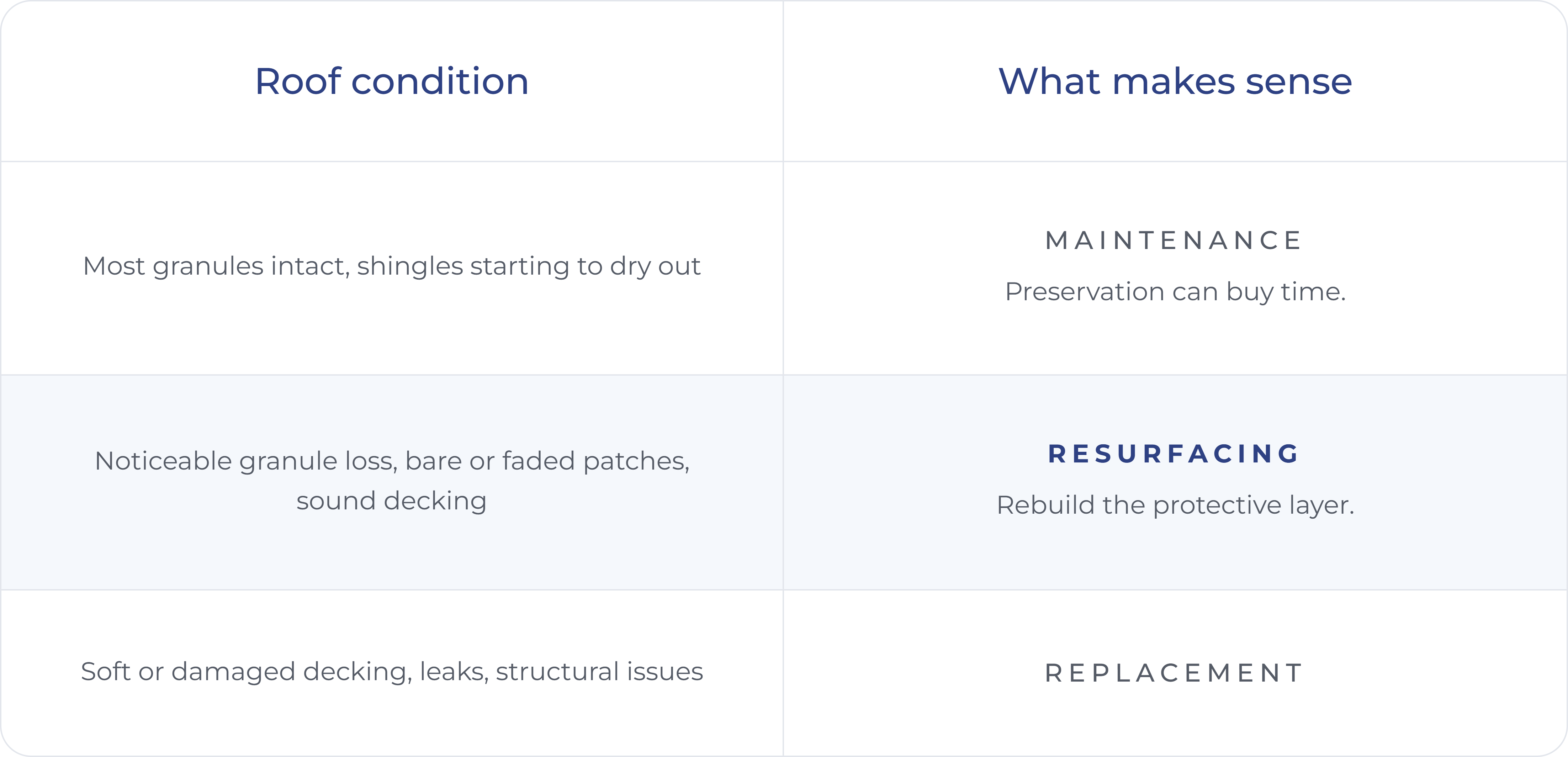
Most rejuvenators are only meant for roofs that still have most of their granules. A good sign you’re past that point: granules piling up in your gutters and downspouts, or washing out onto your driveway and yard. You might also see dark, bare patches on the shingles themselves. At that stage, preserving what’s left doesn’t fix what’s already gone.
Rejuvenating and rebuilding aren’t two versions of the same thing. One maintains what’s there, the other restores what’s gone, and both have their place. So instead of comparing how many years each product promises, ask what it actually puts back on your roof.
Not sure where your roof sits? We’ll take a look and tell you straight. Book a free assessment or find an applicator near you.
Fill out the form below and a member of our team will be in touch to schedule your free in-home assessment.