.png)
The concerns raised about applying coatings to asphalt shingle roofs are legitimate. Here is why Liqua-Roof is a different conversation entirely.
Painting or coating an asphalt shingle roof is generally a bad idea. The roofing industry has said so for years, and they are right. We agree.
Generic roof coatings sold to homeowners have a poor track record. They leave a visibly repainted appearance that looks nothing like a real roof, they lack durability, and they do not address the underlying reason a roof ages — the gradual loss of the mineral granule layer that gives asphalt shingles their color, UV resistance, and surface protection. A coat of paint over a degraded shingle is cosmetic at best and problematic at worst.
Liqua-Roof was built on that exact diagnosis. The goal was never to paint a roof or change its color with a flat coating. It was to restore the granule texture and protection of the original shingle surface — the same look, the same depth, the same performance.
That is the distinction worth understanding.
During manufacturing, asphalt shingles get their color, texture, UV protection, and surface durability from a blend of mineral granules embedded into hot asphalt. Over time, those granules loosen and wash away. What is left is exposed asphalt — dried out, brittle, and increasingly vulnerable.
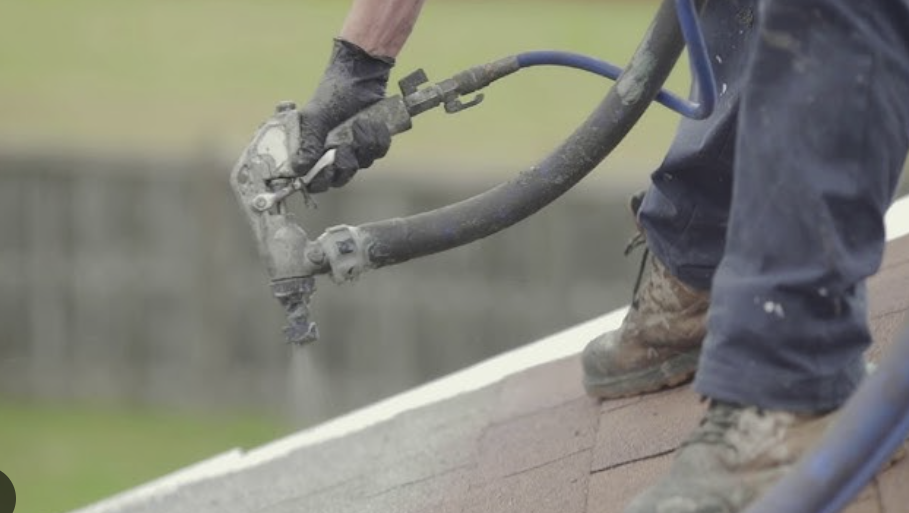
Liqua-Roof does not paint over that problem. It reconstructs the granule layer itself. New roofing granules are reapplied and fully encapsulated along with the remaining granules within a durable binding matrix — permanently locked in place.
The result is a resurfaced roof, not a repainted one. Not recoloring. Not coating. Resurfacing with new granules. That distinction matters for how the roof looks. It matters more for how it performs.
That granule loss has consequences most homeowners never hear about, and some have nothing to do with leaks.
When your asphalt shingles were installed, they came with a fire rating: Class A, B, or C. What most homeowners do not know is that rating does not last forever. By the time a roof needs attention, it may already be significantly degraded.
Asphalt shingles earn their fire classification largely through granule coverage. Those mineral granules embedded in the surface act as a non-combustible barrier between the elements and the asphalt beneath — and asphalt is flammable.
A new shingle with full granule coverage performs exactly as rated. The problem is granules do not stay put. Wind, rain, and UV exposure wear them away over time. As coverage thins, the asphalt beneath becomes increasingly exposed and the fire rating you paid for erodes along with those granules.
Most roof maintenance products do not address this.
Roof rejuvenators — oil-based products that re-saturate dried-out asphalt — can actually add flammability to an already compromised surface depending on the oil used. Standard coatings rely on polymer resins, which are generally flammable. Neither does anything to restore granule coverage.
Liqua-Roof takes a different approach entirely. By reconstructing the granule layer with non-combustible solids applied in meaningful volume, it restores the very surface that drives fire performance — not just the appearance of a healthy roof, but the protection behind it.
In fire-prone regions, or anywhere insurance and building codes are a consideration, that distinction matters.
If you are considering any roof maintenance product, it is worth asking:
Trade association reviews examined dozens of products and found no third-party ASTM compliance, no verified lab data, and marketing claims supported only by testimonials and before-and-after photos.
ASTM D6083 is the foundational standard for liquid-applied coatings on roofing. It measures the physical properties that determine whether a coating will actually hold: adhesion, flexibility, elongation, and tensile strength.
Liqua-Roof exceeds it by over 200% on adhesion alone.
Beyond that, Liqua-Roof has been independently tested across a full ASTM battery:
Plus UL 2218 Class 4 certification, the highest hail impact rating available. The full results are publicly available. The Science Behind Liqua-Roof →
A legitimate concern for vapor-retardant coatings that seal the gaps between shingles. Not a legitimate concern for Liqua-Roof.
The system has a measured vapor permeability of 5.64 perms tested to ASTM D1653 — well above the 1-perm threshold at which building codes classify a material as vapor-permeable. Your attic ventilation continues to work exactly as designed.
Liqua-Roof is designed for roofs that are aging but not yet at full failure — typically with meaningful granule loss, fading, and reduced surface protection. At that stage, the original shingle manufacturer warranty has almost certainly already expired.
The relevant question is not whether a warranty gets voided. It is whether you spend on Liqua-Roof now or spend significantly more on a full replacement.
When a continuous membrane is applied over a shingle roof, it changes the drainage dynamics at shingle laps.
In normal conditions, this is not an issue. But if a flashing is compromised at a chimney, pipe boot, valley, or penetration, water that enters at that point has fewer drainage paths available.
This is why every Liqua-Roof installation begins with a mandatory pre-job inspection. Before the resurfacing layer goes down, a waterproofing membrane is sprayed around all potential water entry points as a protective undercoat when needed.
Flashings, penetrations, valleys — the areas where water has always been most likely to find its way in — are sealed before anything else happens. If flashings need additional attention, they are addressed first. If the roof is not a good candidate, we say so.
The inspection and waterproofing step are not fine-print disclaimers. They are the standard of care a properly engineered resurfacing system should require.
That same membrane that changes drainage dynamics also works in your favor. Ice dams form when snowmelt runs down the roof and refreezes at the eave, forcing water back up under the shingles. On a standard roof, that’s where the damage happens.
Because Liqua-Roof creates a continuous sealed surface, there are no laps for water to exploit. The ice dam can still form, but the water it pushes back has nowhere to go. This is one of the less obvious benefits of the Liqua-Roof system, especially in colder climates.
When a roof starts to age, the options have been to wait it outand accept the risk, or replace a roof that still has structural life which iscostly and disruptive. Liqua-Roof is the third option.
A patented resurfacing system that reconstructs the granule surface that actually drives a shingle roof’s performance.
Independently tested and backed by a 15-year warranty supported by real field history across North America in varied climates and extreme weather conditions.
The only resurfacing solution on the market that actually addresses what aging does to your roof’s protection, appearance, and fire rating.
Before choosing any product in this space, ask:
With Liqua-Roof, the answer to all three is yes.
Fill out the form below and a member of our team will be in touch to schedule your free in-home assessment.


.svg)