When a hailstorm or windstorm damages a roof, most homeowners already know it won't be simple. To make things more complicated, the options typically on the table - partial repair or full replacement - both come with meaningful drawbacks. Partial repairs leave mismatched shingles and unresolved surface damage beyond the replaced shingles. Full replacements mean significant out-of-pocket costs on the deductible, and often higher premiums at renewal on top of that.
There's a third option that most adjusters may not yet know about that can work better for homeowners and makes a compelling case for insurers too!
Not all hail damage is visible from the ground, and not all of it causes an immediate leak. The damage follows a progression that matters for how a claim gets scoped.
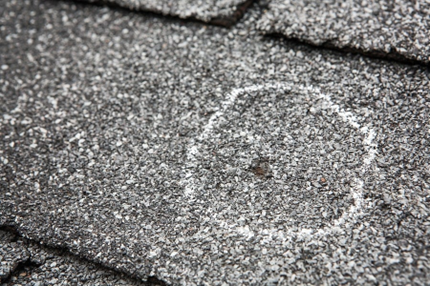
The most common outcome is granule loss. The mineral granules embedded in the shingle surface get dislodged by impact, leaving the underlying asphalt exposed. Those granules aren't just cosmetic, they protect the asphalt from UV degradation, regulate surface temperature, and contribute to the roof's fire resistance rating. Once they're gone, the asphalt dries out, becomes brittle, and the roof's remaining service life shortens considerably. This is latent damage: no immediate leak, but a roof that's now measurably more vulnerable to the next storm and to UV exposure.
More severe hail causes bruising - a fracture that begins at the base of the shingle and works upward through the fiberglass mat. A bruised shingle feels soft underfoot and has compromised structural integrity even without a visible crack on the surface. At the most severe end, large or wind-driven hail cracks or punctures shingles outright, creating direct pathways for water infiltration.
One thing worth noting: not all granule loss on a storm-damaged roof is hail-related. Blistering caused by heat and moisture trapped in the shingle produces similar surface deterioration but from a different mechanism entirely. A qualified inspection can distinguish between the two, which matters when a claim is being scoped.
The size of the hail matters, but so does wind speed, shingle age, and whether rain accompanied the storm. A rain-cooled roof is harder and more prone to granule displacement. A dry, sun-warmed roof is softer and more prone to bruising. Two roofs hit by the same storm can present differently depending on those conditions.
Wind damage is often more visible than hail damage but carries a hidden dimension that standard repairs tend to miss.
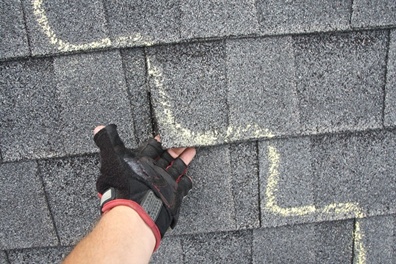
High winds lift shingle tabs, breaking the factory adhesive seal along the shingle's edge. In stronger events, shingles are displaced or removed entirely. The visible damage is straightforward to scope and repair. The hidden problem is the shingles that look completely intact, but whose adhesive bond has been broken or compromised. They lie flat, they pass a visual inspection, and they will likely lift again and potentially break during the next weather event.
Standard repair practice replaces the obviously damaged shingles. The compromised-but-intact shingles surrounding them get left in place, their weakened bond unaddressed.
Partial repairs consistently leave two problems unresolved.
The first is color matching. Roofing manufacturers update their product lines regularly, and even when the same shingle is nominally available, weathering means new shingles will never visually match aged ones. Most insurance policies include a matching obligation - the requirement that repairs restore the roof to a reasonably uniform appearance. Partial shingle replacement rarely satisfies that standard cleanly, and the gap between what was installed and what the policy requires is where disputes tend to begin.
The second is surface performance. Replacing a handful of shingles restores those specific spots. It does nothing for the surrounding field of shingles that absorbed the same storm. A roof where significant granule loss exists across most of the surface but only a few shingles were swapped isn't restored to pre-loss condition in any meaningful sense.
Here's where the financial picture gets important for everyone involved.
Most homeowners assume their wind and hail deductible is calculated against the cost of the roof. It isn't. Percentage-based deductibles - now standard in most storm-prone markets - are calculated against the full reconstruction value of the entire home. A 2% wind/hail deductible on a home insured for $400,000 means the homeowner pays $8,000 out of pocket before insurance contributes anything. At 3%, that's $12,000.
A full roof replacement on that same home typically runs $15,000 to $20,000. Which means a homeowner with a 2-3% deductible is personally covering anywhere from 40% to 80% of the total replacement cost before their policy pays a dollar. The insurer is covering the rest - a significant claims payout that affects their loss ratio and ultimately the homeowner's renewal premium. Nobody wins in this scenario.
And it doesn't end there. A replacement claim often triggers a premium re-evaluation at renewal. The financial impact of a storm doesn't show up only in the repair bill - it follows the homeowner for years. It's a cycle nobody enjoys, and one that partial repairs and expensive replacements both perpetuate.
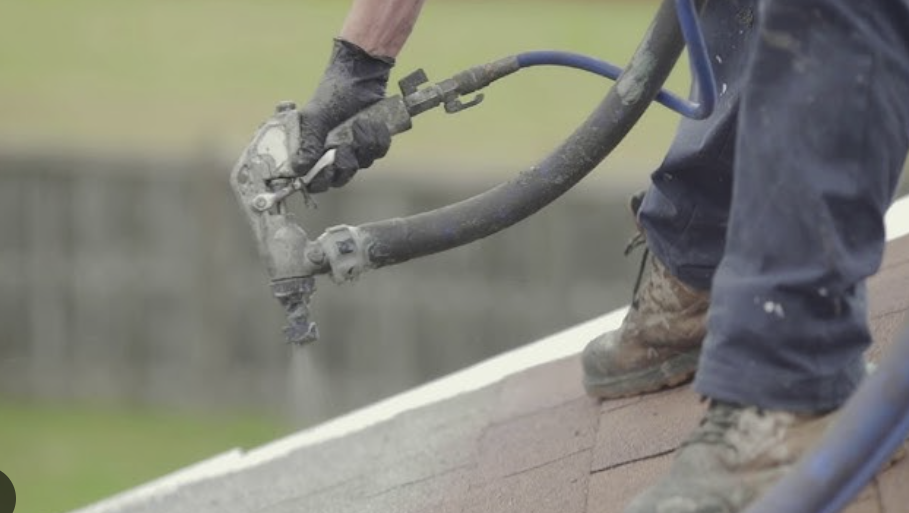
Liqua-Roof is a patented roof resurfacing system that rebuilds the granule layer across the entire shingle surface. It isn't a coating. It's a resurfacing process - engineered around the same mineral granules used in shingle manufacturing, applied in sufficient volume to restore UV protection, fire resistance, and long-term weathering performance. It is ASTM-tested and backed by a 15-year warranty. Learn more about the science behind Liqua-Roof.
The workflow for a storm-damaged roof is straightforward. Shingles that are structurally compromised - cracked, punctured, or lifting -- get replaced first as needed. For wind-damaged roofs, shingles with broken adhesive seals get re-adhered or replaced as needed.
Then Liqua-Roof is applied across the entire roof surface. The color matching problem gets resolved as a byproduct - the entire roof surface comes out looking like new.
.png)
For wind claims specifically, Liqua-Roof addresses the hidden adhesive seal problem that standard repairs can miss. By bonding the entire surface layer together, it locks shingles down from the top across the full roof - not just at the spots where damage was visible.
No roof is storm-proof. Liqua-Roof doesn't change that. What it does is restore a degraded surface to a condition where it can perform as intended and give the roof a genuine fighting chance against whatever comes next. Liqua-Roof's proprietary resin blend embeds the remaining existing granules while GranuLock technology locks the new granule layer in place - completely enveloped, shedding 90% less than a new roof (ASTM D4977). The result is a surface with materially enhanced impact and wind resistance, backed by independent ASTM D2794 testing showing three times the impact resistance of a standard UL 2218-rated shingle. The roof that comes out of this process isn't just restored - the data demonstrates it's stronger.
The average Liqua-Roof job runs approximately $7,500 - less than half the cost of a full replacement, and in many cases, less than the deductible a homeowner would owe on a replacement claim. That's worth a direct conversation with your adjuster. Ask whether a resurfacing scope qualifies for partial or full coverage under your policy. At that price point, even partial coverage meaningfully changes what comes out of your pocket, and gives your insurer a claim they can close at a fraction of replacement cost.
The matching obligation gets satisfied cleanly. The surface performance is restored across the entire roof. And the claim closes without the disruption of a full tear-off, which is typically a multi-day job with significant noise, debris, and scheduling.
A storm claim is a transaction. What happens to your roof - and your coverage - in the years around it is where the real cost lives.
Hail and wind losses have increased significantly across North America over the past decade. Insurers have responded by tightening underwriting standards around roof condition - a reasonable response to a real problem. Significant granule loss, visible surface deterioration, or a roof approaching the end of its rated life can now factor into renewal decisions, sometimes resulting in requirements to remediate before coverage continues.
For homeowners in that position, the choice can feel stark: replace the roof or risk losing coverage. Liqua-Roof offers a third path. A resurfaced roof with a fresh 15-year warranty is a documented, warranted system that gives underwriters something concrete to evaluate. For homeowners navigating a renewal requirement, it can be the option that keeps coverage intact without the full cost and disruption of replacement - and gives insurers the condition improvement they're looking for at a fraction of the claims exposure.
Roof age is a related pressure point. Many carriers limit coverage or decline to write new policies on roofs beyond 15 to 20 years old. A structurally sound roof at year 14 with surface wear shouldn't necessarily be a replacement candidate - but without intervention, it's heading toward that conversation. A Liqua-Roof resurfacing with a 15-year warranty extends the insurable life of a roof that still has good structural bones, giving both the homeowner and the insurer a better outcome than forced replacement.
For homeowners who've already been through one storm, there's a forward-looking argument worth considering. A roof that's been resurfaced isn't starting from zero when the next storm hits. The granule layer is rebuilt, the surface is bonded, and independent ASTM testing demonstrates the result is stronger than a new roof. The system carries a 15-year warranty backed by third-party data. That's a measurably stronger position than a roof that was partially repaired and otherwise left as-is, and that kind of documented performance improvement is exactly the basis on which carriers assess and price risk over time.
The roofing insurance world has long operated on a binary: repair or replace. Repair is cheap but incomplete. Replace is thorough but expensive - and with deductible structures the way they are, homeowners are shouldering a disproportionate share of that cost while insurers absorb a significant claims hit. Nobody wins in that scenario, and the premium consequences that follow make it worse for everyone.
Liqua-Roof fits as a third category. The practicality and cost of a repair, with the performance and warranty of a restored roof. For adjusters evaluating storm claims, it represents a legitimate scope of work that satisfies matching obligations, restores documented surface performance, and closes claims at significantly lower cost than full replacement. For underwriters managing renewals, a resurfaced roof with a 15-year warranty and third-party tested performance data is a concrete improvement in risk profile - the kind of documented condition change that should factor into how coverage is written and priced.
The testing exists. The performance data is there. Roof resurfacing as a recognized claim and renewal category is a natural next step - the same path impact-resistant shingles already traveled.
Adjusters and carriers looking to evaluate Liqua-Roof as a claim option are welcome to reach out directly at info@liquaroof.com.
Fill out the form below and a member of our team will be in touch to schedule your free in-home assessment.


.svg)

.png)